Showing posts with label dams. Show all posts

Wednesday, January 28, 2015

A river-friendly dam? Poutès update

Hydroelectric dams may produce clean energy but they generally mess up a river.  Still, a redesigned dam in the mountains of central France might be a model for accommodating river environments with energy production.

© Richard Mounts
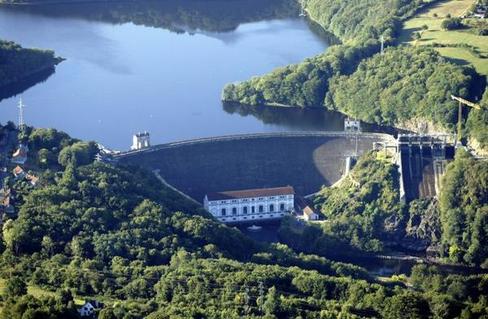
Since 1941, a 56-foot high dam in the upper reaches of the Allier River at a place called Poutès has generated power for Électricité de France (EDF).  For years, environmental groups argued that the dam blocked migrating salmon from reaching spawning groups and disrupted the river valley ecology by interfering with the normal flow of sediments.

EDF’s operating license expired in 2007 and environmentalists opposed renewal.  They wanted to see the dam decommissioned and dismantled, as had been done a few miles upstream at Saint-Étienne-du-Vignan (in the department of the Lozère near Naussac Lake).  On the opposite side, public officials and others pushed to preserve a source of clean energy and, along with it, the tax revenues to local communities.
Existing dam.  ©EDF

The standoff was finally resolved in July 2011 when EDF presented a new version of the dam.  This design would lower the dam to just 13 feet and would include accommodations for fish and sediments.  For the last three years, EDF has been building and testing a 1/13th scale model of the “new Poutès”; they avoid calling it a dam.  Besides redesigned fish ladders, the new installation will include special valves to be opened during high-water periods to allow sediment flow.  A lower barrier will also mean a smaller reservoir and a more natural river valley.  Currently, the water backs up for more than two miles.  When the new structure is completed, this will drop to about 300 yards.  Even with the much lower structure and freer water flow EDF expects to continue to generate 85 percent of the power current output.

Proposed dam.  ©EDF
The project is back in the news (at least in the Haute-Loire) because a public comment period opened at the beginning of this month.  The issue is still the decision by the Ministry of the Environment to grant EDF a new 50-year operating license.  At the beginning of January, residents in the 26 small communities along the affected portion of the river all received a brochure with information about the project and how to submit opinions.  This time, given support among all the previously contending parties, serious opposition seems unlikely.  The comment period closes on February 5 and some expect government approval within a couple of months.  EDF says it would start construction towards the end of 2016, with completion likely in about three years.

Wednesday, February 19, 2014

The Cher "Canalized"


La Nouvelle République recently included a curious article about the Cher River and an organization, “Le Syndicat du Cher canalisé.”

Copyright La Nouvelle République
The article describes the organization’s plans for 2014, which are supposed to include renovation of dams on the Cher, regulation of its flow, and balancing recreational use and environmental preservation.  The article’s tone was entirely matter-of-fact; no issues; nothing about the possibility that the Syndicat’s plans for the dams, for example, might raise any questions.

It made me curious about a river described as canalisé and an organization that aims to preserve that condition by restoring dams and yet also claims to be preserving the environment.

A separate organization, “Les Amis du Cher Canalisé,” offers an interesting history of transporation on the river.  In 1828 the Canal du Berry opened as far as Noyers-sur-Cher providing the first part of a link between Montluçon and Tours.  The second part involved building a series of needle dams and locks to allow barges to connect to the Loire at Tours.  Needle dams, developed in France at the beginning of the 19th century, are a type of low dam made of wooden slats, or needles.  They aren’t intended to be water tight and needles can be added or removed to control the water level behind.  The series of these dams on the Cher was completed in 1841.  “Canalisé,” it turns out, doesn’t mean “channelized,” in the sense of the arrow-straight, cement-lined troughs the U.S. Army Corps of Engineers likes to construct.  It means, rather, that, with the needle dams, the river could be used for transport as if it were a canal.  And it appears it was.  The “Amis” cite records reporting that 4,600 barges passed along the canalized portion in 1846.  By the 1920s, this canal, like most others, had lost out to railroads and roadways.  Eventually, in 1955, the national government removed the canal from its list of navigable waterways and responsibility for the canalized portion was handed over to the two departments through which it flows, the Indre-et-Loire and the Loir-et-Cher.  For several years, the departments pretty much ignored the river.  Then, in the 1990s, they became interested in the recreational and tourist potential.  Through an interdepartmental entity, the Syndicat, they started restoring the needle dams to provide water deep enough for boating and canoeing and, eventually, a floating restaurant.

Meanwhile, in 2002, the national government declared the Cher to be a natural habitat for several migratory species of fish, including lampreys, shad, and eels.  Within five years, dams would need to be modernized to allow for their passage.   More or less since then there have been an on-going tensions between the Syndicat and Amis on one side, and environmental organizations on the other.

Recently, SOS Loire Vivante and several other environmental and fishing organizations have written to local authorities objecting to recent repairs to several of the needle dams damaged in flooding in 2013.  They note that the dams have not been modified to provide for migratory species as the law requires.  They propose what they term a compromise under which some of the dams would be maintained, provided they’re modified to accommodate migratory fish, and others would be dismantled.

Thursday, June 6, 2013

Peaking releases and fish

Hydropower may be a clean, renewable form of energy, but putting a dam across a river certainly has consequences for life in and along a river.  This is particularly true when the power station operates in a "peaking" manner, periodically releasing water from the reservoir to supply extra power.

Recently, France's Fédération Nationale pour la Pêche (National Federation for Fishing) and Électricité de France (EDF) announced the results of a joint six-year study (2006-2011) of the impacts on the down-stream fish populations of these peaking releases (referred to as "éclusées" from the opening of the "écluses" or locks to release the water).  The report covered the first phase on an on-going evaluation and looked at water releases from the dams at La Roche-aux-Moines and Éguzon, both on the Creuse River about 50 km south of Châteauroux (about 150 km southeast of Tours and the Loire River).  Data was collected at some 50 points identified as fish spawning grounds.

Éguzon Dam.  © La Nouvelle République and Patrick Gaïda

Somewhat surprisingly, the study found that the impacts weren't all negative; they varied according to species of fish.  Some seemed to do just fine; others not so fine.  Among the former were barbels, a small carp-like fish, and chub.  Among the latter were perch, trout, and sanders, all of which showed declining numbers.


Already, EDF has agreed to modify its water releases to keep the downstream water levels within specified minimum and maximum amounts.  As reported in the newspaper La Nouvelle République the fishermen and the power company, having collaborated in this project, seemed anxious to find ways to manage the river to satisfy everyone's concerns, or at least those of fishermen and power generators.  I'm curious, though, about what regulatory requirements apply to habitat protection along rivers in cases like this, and the extent to which those are taken into account.  Is there a possibility that governmental agencies may be ceding responsibilities to private interests in this case?

Wednesday, January 2, 2013

A French dam -- Poutes on the Allier

A committee monitoring modifications to the Poutes Dam is reported to have had another productive meeting back in early December.  About 30 representatives of local governments, environmental groups, and others met in Le Puy-en-Velay under the direction of the préfet of the department of the Haute-Loire.  They were reviewing details of a project to transform a 17-meter-high (about 56 feet) structure that currently blocks access to spawning grounds for Atlantic salmon, into one about 4 meters high (about 13 feet) with up-to-date fish ladders.  Since construction in the midst of World War II, the dam has directed water through pipes to turbines downstream at Monistrol d'Allier generating about 82,000 megawatts of electricity annually.  It’s expected that, even with the dam at a quarter of the former height, electricity production should only fall by about 10 to 15 percent.

Existing and modified Poutes dam.  Source: zoomdici.fr

The Poutes dam is on the Allier River in the department of the Haute-Loire, about 35 km south of Le Puy-en-Velay.  It's a remote and mountainous part of France known, if at all, for the Beast of the Gevaudan, a giant wolf said to be responsible for the deaths of many peasants in the mid-18th century, and for Robert Louis Stevenson's travels in the area in 1878 with his donkey Modestine.
 

In advance of the expiration of EDF's (Électricité de France) operating license in 2007, environmentalists began trying to persuade authorities to deny renewal.  They argued that dismantling the dam would be an important step in restoring salmon to the river.  Dams and over-fishing had nearly eliminated the fish from the Loire and Allier until, in the 1990s, the government, prompted by environmental organizations, committed to a long-term restoration project.

Local government officials and some union organizations in the area expressed concern about losing EDF’s tax payments and undermining economic development efforts.  Generally, opponents argued, removing the dam would only marginally help the fish since they need to travel so far to get there and there are many other obstacles encountered along the way, so many, in fact, that relatively few salmon make it to Poutes.  They also argued that hydropower, as a clean form of energy, should be encouraged.

The government finally resolved the issue in July 2011 when it agreed to renew EDFs’ license based on the company’s proposed design for the lower version of the dam.  Generally, both sides expressed approval.

This is not as dramatic an environmental issue as many I’ve highlighted here.  It involves a smallish dam in a remote part of France.  But I have a couple of reasons for my interest.  One is personal; I visited Le Puy and the Haute-Loire in 2011 and one day I drove out to see the dam.  Since then, I’ve been trying to follow implementation of the redesign.  The second reason is more general.  There are lots of rivers in France, in the U.S. and in other countries with similar old dams producing relatively small amounts of power.  The issues involved in the Poutes conflict are probably relevant to the future of most of these dams, essentially restoration of a natural habitat vs maintaining a source of clean electricity.  The solution at Poutes, one that’s largely technical, seems like it could be relevant in other places.