Showing posts with label energy policy. Show all posts

Wednesday, January 28, 2015

A river-friendly dam? Poutès update

Hydroelectric dams may produce clean energy but they generally mess up a river.  Still, a redesigned dam in the mountains of central France might be a model for accommodating river environments with energy production.

© Richard Mounts
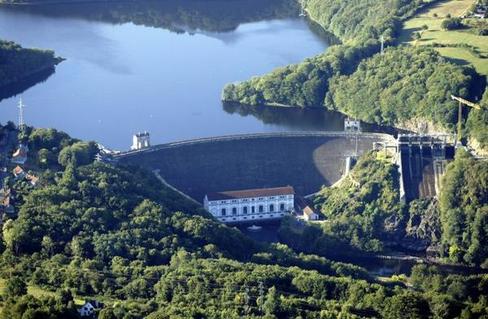
Since 1941, a 56-foot high dam in the upper reaches of the Allier River at a place called Poutès has generated power for Électricité de France (EDF).  For years, environmental groups argued that the dam blocked migrating salmon from reaching spawning groups and disrupted the river valley ecology by interfering with the normal flow of sediments.

EDF’s operating license expired in 2007 and environmentalists opposed renewal.  They wanted to see the dam decommissioned and dismantled, as had been done a few miles upstream at Saint-Étienne-du-Vignan (in the department of the Lozère near Naussac Lake).  On the opposite side, public officials and others pushed to preserve a source of clean energy and, along with it, the tax revenues to local communities.
Existing dam.  ©EDF

The standoff was finally resolved in July 2011 when EDF presented a new version of the dam.  This design would lower the dam to just 13 feet and would include accommodations for fish and sediments.  For the last three years, EDF has been building and testing a 1/13th scale model of the “new Poutès”; they avoid calling it a dam.  Besides redesigned fish ladders, the new installation will include special valves to be opened during high-water periods to allow sediment flow.  A lower barrier will also mean a smaller reservoir and a more natural river valley.  Currently, the water backs up for more than two miles.  When the new structure is completed, this will drop to about 300 yards.  Even with the much lower structure and freer water flow EDF expects to continue to generate 85 percent of the power current output.

Proposed dam.  ©EDF
The project is back in the news (at least in the Haute-Loire) because a public comment period opened at the beginning of this month.  The issue is still the decision by the Ministry of the Environment to grant EDF a new 50-year operating license.  At the beginning of January, residents in the 26 small communities along the affected portion of the river all received a brochure with information about the project and how to submit opinions.  This time, given support among all the previously contending parties, serious opposition seems unlikely.  The comment period closes on February 5 and some expect government approval within a couple of months.  EDF says it would start construction towards the end of 2016, with completion likely in about three years.

Thursday, June 6, 2013

Peaking releases and fish

Hydropower may be a clean, renewable form of energy, but putting a dam across a river certainly has consequences for life in and along a river.  This is particularly true when the power station operates in a "peaking" manner, periodically releasing water from the reservoir to supply extra power.

Recently, France's Fédération Nationale pour la Pêche (National Federation for Fishing) and Électricité de France (EDF) announced the results of a joint six-year study (2006-2011) of the impacts on the down-stream fish populations of these peaking releases (referred to as "éclusées" from the opening of the "écluses" or locks to release the water).  The report covered the first phase on an on-going evaluation and looked at water releases from the dams at La Roche-aux-Moines and Éguzon, both on the Creuse River about 50 km south of Châteauroux (about 150 km southeast of Tours and the Loire River).  Data was collected at some 50 points identified as fish spawning grounds.

Éguzon Dam.  © La Nouvelle République and Patrick Gaïda

Somewhat surprisingly, the study found that the impacts weren't all negative; they varied according to species of fish.  Some seemed to do just fine; others not so fine.  Among the former were barbels, a small carp-like fish, and chub.  Among the latter were perch, trout, and sanders, all of which showed declining numbers.


Already, EDF has agreed to modify its water releases to keep the downstream water levels within specified minimum and maximum amounts.  As reported in the newspaper La Nouvelle République the fishermen and the power company, having collaborated in this project, seemed anxious to find ways to manage the river to satisfy everyone's concerns, or at least those of fishermen and power generators.  I'm curious, though, about what regulatory requirements apply to habitat protection along rivers in cases like this, and the extent to which those are taken into account.  Is there a possibility that governmental agencies may be ceding responsibilities to private interests in this case?

Saturday, February 9, 2013

Italian parties on energy and the environment

With elections now barely two weeks away, two Italian economists have searched through statements of party programs to see what they say about energy and the environment.  In general Caterina Miriello and Antonio Sileo, writing for Lavoce.info, found lots of pious wishes and little discussion of financing.  Here's my summary of their very useful summary:

Partito Democratico (PD).  Befitting a party of the left, energy and environmental matters appear in the context of jutice and equality.  The PD says Italians should have equal access to "common goods," which includes energy.  Statements about "sustainable development" include a collection of proposals for supporting innovative small domestic businesses.

Sinistra, Ecologia e Libertà.  Nicchi Vendola's party program has a lot to say about developing renewable energy technologies and energy efficiency, but is silent on financing.

Popolo della Libertà.  Berlusconi may offer the greatest number of pious wishes, some of which appear inconsistent, as in encouraging utility companies to invest in new technologies, but promising to reduce household energy bills.

Movimento 5 Stelle
.  M5S's program may be the most detailed.  Generally it proposes to meet new energy needs through improvements in energy efficiency.  And the program spells out how this could be done, including financial proposals.  But Miriello and Sileo are concerned about the numbers; they don't seem to have any authoritative sources.

Agenda Monti
.  Monti's group has relatively little to say about energy and environmental matters.  The program mentions energy from waste materials, without including many details.  It also stresses an idea that apparently has been discussed for a while -- that of making Italy the entry and distribution point for imported natural gas.  Miriello and Sileo aren't sure what the financial markets think about the idea these days.

Thursday, January 31, 2013

Less light in Paris

It's going to be darker in Paris next time you're trying to find your way back to the hotel in the wee hours.  The Ministry of Ecology has just started implementing regulations limiting nighttime lighting.  Generally, the new rules require non-residential buildings to turn off all outside lights by 1 a.m. at the latest.  This applies to both public and privately-owned buildings.  So no more window shopping after 1 a.m.; no more brightly-lit public monuments as landmarks on the way home.

It may not be the most dramatic energy conservation measure, but the Ministry expects these lighting rules to produce significant savings.  Nationally it projects they'll cut annual electricity consumption by about 2 terawatt hours, or the equivalent of annual electricity consumption by 750,000 households.  Besides energy savings, it should reduce risks for nighttime migratory birds.  Lit-up buildings confuse and attract birds flying overhead.  Often, in cities everywhere, part of a janitor's early morning work is picking up dead birds that smacked into a building's windows or glass exterior during the night.

Still, if you're worried about France rolling up the sidewalks and turning into Omaha, you should know that the rules provide for exceptions.  The country is well-aware of what it owes to tourists.  Several parts of Paris, including the Champs-Elysées, Montmartre, the rue de Rivoli, and the Place des Vosges, can leave the lights on.  This is also true for parts of cities like Nice and Marseille and Lyon.  But now, at least when you get back to your small hotel on a side street, that neon light above the garage across the way that flashed all night long through the window, should be dark.

Friday, January 4, 2013

Ungersheim -- post petroleum laboratory

We imagine France as a country where everything comes from Paris.  There’s truth to that, but only some.  Outside the capital, regional and local governments innovate more than we might expect.  Take for example Ungersheim a town of about 2,000 in Alsace, close to the German border.   Le Monde reports that two days after Christmas, the town inaugurated a solar-powered electric generating station.  At 2.2 MW, it's quite small in comparison to, say, the the Agua Caliente Project in Arizona, where photovoltaics generate 200 MW.  Still, it's estimated to be enough to supply 800 households and Ungersheim will receive rent and a small portion of operating revenues from the operator.

Photo by Grégoire Gauchet, Dernieres Nouvelles d'Alsace
 The solar power plant is part of “21 actions for the 21st century," a project lead by Ungersheim’s mayor of 20 plus years, Jean-Claude Mensch.  Mensch, a former miner and union activist, aims to bring new ideas to a region that still remembers hard times after the mines closed.  In meetings with local residents, he and members of the local council worked out ideas for “sustainable development.”  Thus, besides the solar power plant, the municipal swimming pool is now heated by solar panels.  Municipal lighting levels have been reduced to limit light pollution and lower costs.  A new “éco-hameau” residential area will have no cars and target zero carbon emissions.  The town regained control of water treatment and distribution and operates with rates 5 to 20 percent below those of nearby communities.  And more.  Le Monde refers to it as a “post petroleum laboratory.”

I'm interested to follow implementation of all of these 21 actions and to see whether Ungersheim and the aptly-named Mayor Mensch have a wider influence.

Wednesday, January 2, 2013

A French dam -- Poutes on the Allier

A committee monitoring modifications to the Poutes Dam is reported to have had another productive meeting back in early December.  About 30 representatives of local governments, environmental groups, and others met in Le Puy-en-Velay under the direction of the préfet of the department of the Haute-Loire.  They were reviewing details of a project to transform a 17-meter-high (about 56 feet) structure that currently blocks access to spawning grounds for Atlantic salmon, into one about 4 meters high (about 13 feet) with up-to-date fish ladders.  Since construction in the midst of World War II, the dam has directed water through pipes to turbines downstream at Monistrol d'Allier generating about 82,000 megawatts of electricity annually.  It’s expected that, even with the dam at a quarter of the former height, electricity production should only fall by about 10 to 15 percent.

Existing and modified Poutes dam.  Source: zoomdici.fr

The Poutes dam is on the Allier River in the department of the Haute-Loire, about 35 km south of Le Puy-en-Velay.  It's a remote and mountainous part of France known, if at all, for the Beast of the Gevaudan, a giant wolf said to be responsible for the deaths of many peasants in the mid-18th century, and for Robert Louis Stevenson's travels in the area in 1878 with his donkey Modestine.
 

In advance of the expiration of EDF's (Électricité de France) operating license in 2007, environmentalists began trying to persuade authorities to deny renewal.  They argued that dismantling the dam would be an important step in restoring salmon to the river.  Dams and over-fishing had nearly eliminated the fish from the Loire and Allier until, in the 1990s, the government, prompted by environmental organizations, committed to a long-term restoration project.

Local government officials and some union organizations in the area expressed concern about losing EDF’s tax payments and undermining economic development efforts.  Generally, opponents argued, removing the dam would only marginally help the fish since they need to travel so far to get there and there are many other obstacles encountered along the way, so many, in fact, that relatively few salmon make it to Poutes.  They also argued that hydropower, as a clean form of energy, should be encouraged.

The government finally resolved the issue in July 2011 when it agreed to renew EDFs’ license based on the company’s proposed design for the lower version of the dam.  Generally, both sides expressed approval.

This is not as dramatic an environmental issue as many I’ve highlighted here.  It involves a smallish dam in a remote part of France.  But I have a couple of reasons for my interest.  One is personal; I visited Le Puy and the Haute-Loire in 2011 and one day I drove out to see the dam.  Since then, I’ve been trying to follow implementation of the redesign.  The second reason is more general.  There are lots of rivers in France, in the U.S. and in other countries with similar old dams producing relatively small amounts of power.  The issues involved in the Poutes conflict are probably relevant to the future of most of these dams, essentially restoration of a natural habitat vs maintaining a source of clean electricity.  The solution at Poutes, one that’s largely technical, seems like it could be relevant in other places.

Tuesday, December 11, 2012

Tax on natural gas?

Suddenly people are excited about the U.S. becoming energy independent.  Somehow it seems this happened while I was looking in the other direction.  The reason for the excitement is clearly tied to expectations for domestic natural gas development.  Sunday’s Washington Post, for example, included two pieces dealing with the potential for not only supplying domestic needs for natural gas but also for providing exports to world markets.

One of these, a column by Steven Pearlstein, reviews the debate over allowing exports vs. keeping supplies at home.  The former means prices will go up while the latter would keep them lower.  Pearlstein favors allowing exports but, at the same time, applying a federal tax at the wellhead to limit gas company profits and ease the impact of higher prices on consumers.

The idea of the tax, whatever its political possibilities, seems a good one.  But what if it were made part of a broader, longer-term policy of energy independence?  The U.S. does have the potential for very large natural gas supplies.  But even if all of the “technically recoverable” supplies became available, the U.S. Energy Information Agency estimates that, at current consumption rates, these would supply domestic needs for 92 years.  That’s a long time, but it’s not forever, far from it.  It’s likely that many of the babies born today will live that long.  And, although gas-fired power plants pollute less than do coal-fired plants, as the Natural Resources Defense Council points out, natural gas is still a fossil fuel and it’s use does add CO2 to the atmosphere.

My sense is that most of the debate over natural gas production has concentrated on “fracking” techniques and their environmental risks.  These are important issues.  From what I can tell, most regulation has been left to the state governments, who have been more interested in tax revenues than environmental protection.
 

Meanwhile, domestic production of natural gas has increased remarkably to the point that there is now this pressure on the Energy Department to license exports.  This makes Pearstein’s tax proposal really interesting.  But I would hope that the discussion about any tax -- if there is any discussion -- would be connected to plans for an energy transition involving more efficient use (i.e., conservation) and renewables. 

Tuesday, December 4, 2012

Carbon tax in the U.S.?

Elizabeth Kolber, in the current New Yorker, [subscription required] reminds us that global warming is a very large problem of externalities, that is, costs of private actions imposed on the general public.  People using fossil fuels -- car owners and utilities burning coal and gas -- discharge CO2 into the atmosphere, add to the greenhouse effect, which heats up the planet, which ends up creating the havoc of storms like Hurricane Sandy.  The idea behind a tax on these fuels is to require users to pay for some of the environmental costs they help create with their CO2 emissions.  A carbon tax would have other benefits.  She cites a Congressional Budget Office report stating that a “relatively modest” tax on gasoline and other fossil fuels could cut the federal deficit in half.  How could this not be politically attractive?
 

So how attractive is the idea?  Kolbert reports considerable support from both liberal and conservative economists and quite a number of corporations, including ExxonMobil.  Unfortunately, the Obama administration, so far at least, isn’t at all attracted to the idea.  Maybe, after “fiscal cliff” issue have been resolved, the President could turn his attention to climate change, an issue he has repeatedly said has a high priority. 

Sadly, though, even after the current tax and budget issues have been resolved, House Republicans promise a new confrontation over the debt ceiling.  And this sort of action is likely to continue at least through the 2014 congressional elections.  In a sense, the carbon tax is another example of how House Republicans are stalemating efforts to deal with obvious public problems.  In this case they’re not doing it directly; yet, by opposing virtually every significant legislative proposal, they raise the political costs for the Administration, thereby limiting the range of what can be proposed to just a handful of critical issues.

Wednesday, November 28, 2012

France's debate over energy transition

France is using an interesting approach to developing policies for “the energy transition.”  Rather than develop these internally, François Holland’s government has chosen to organize “national debate” on the country’s energy future.  The debate is to begin tomorrow, 29 November.  It is expected to produce a set of legislative proposals to be proposed in 2013.  The minister of ecology, Delphine Batho, will be leading a working committee of six energy experts.  Although the Le Monde article reporting on the event isn’t completely clear, it appears that this group is charged with distilling the debate and preparing initial draft proposals.

Tomorrow, the discussion will begin with a group of technical experts presenting several possible energy futures.  These, in turn, will be debated by representatives of seven “colleges” including unions, management, local elected officials, members of the Assembly, consumer organizations, environmental organizations, and members of the government.  Several environmental groups have expressed unhappiness over the make-up of the working group, particularly the presence of two individuals considered pro-nuclear.  Greenpeace and Friends of the Earth decided not to participate.  Reportedly, they objected in some manner to the way the debate was being organized and to the delay in fixing the date.

I’m curious about this “national debate” as an approach to governance.  In theory, Holland and the Socialist Party could have offered a program for energy transition during the presidential campaign earlier this year.  For whatever reason they didn’t.  Maybe they felt it was too risky a subject and their first priority was to get elected.  So now what?  How much shaping and direction does the government apply?  How open is the debate?  What happens once the working group goes to work?  I’m somewhat skeptical of the "national debate" model, but I'm very interested to see how it works.