Tuesday, July 23, 2013

"Bonheur"


I took the pieces of my bicycle out of its travel case yesterday and put it back together.  I was staying with a friend in Paris and I'd found some shade in the courtyard of her apartment building; I was hurrying to be done before the temperatures went into the 90s.  (And here I'd thought I'd be escaping Washington D.C.'s heat when I got to Paris.)  At one point, I dropped a small screw.  I found it again right away, but it occured to me then how much this whole project depends on this seemingly fragile machine.  One piece missing or broken and all the planning is up in the air.

Maybe if I gave the bike a name it would feel more like part of the family and be on its best behavior.  But I've had it for nearly ten years without knowing it as anything other than "the Hampsten," so it's probably too late for that sort naming, personification thing.  In any case, as long as I don't lose critical pieces, the bike has always (knock on wood) been highly reliable.

So I'm off for a month or riding down the Loire River.  Last night, the apartment across the courtyard seemed to offer what I'm glad to take as an encouraging sign of what's ahead.


Thursday, July 4, 2013

The Minister takes her leave


Well, she certainly didn't just hand over the keys to her office and go home.  Delphine Batho, recently dismissed from her position as French Minister of the Environment, gave a press conference today in which she took aggressive shots at the Prime Minister, Jean-Marc Ayrault and certain "economic lobbies" that wanted her out.  Her remarks have been called "politically naive," and they probably were.  All of the blame was directed elsewhere, for example, none her own way.

But her political inexperience and lack of press conference skills shouldn't obscure the fact that the Hollande/Ayrault government, when it chose her ministry to take the largest budget cuts in its 2014 budget, announced that, to put it mildly, environmental programs were way, way down on its list of priorities.  That, to me,  has a lot more significance than Ms. Batho's press conference.

The government's priorities may be jobs, and correctly so.  But, more like socialists of 40 or more years ago, they seem to act as if jobs mean infrastructure and regional economic development.  It's as if they're out to recreate the "Trentes Glorieuses" the 30 years of post-war economic growth.  Thus Ayrault's Notre-Dame-de-Landes airport project just west of Nantes where he was mayor for many years, justified as critical for economic growth in that part of western France.  No one in the government seems much interested in what all this does to land and water resources, or whether the jobs being created will still be around in five or ten years.

Meanwhile, Ms. Batho retains a seat in the National Assembly as a deputy from the Deux Sèvres, a largely rural district directly south of Angers and the Loire River.  I don't have the impression she was particularly identified with environmental issues before being name to her ministerial position.  Nor has she been that close to EELV (Europe Écologie Les Verts) party members.  It will be interesting what role she plays now.

Tuesday, July 2, 2013

Budget cut, environment minister gone

French president François Holland's government recently announced its budget for 2014 with more cuts in public spending; the agency taking the biggest hit turned out to be the Ministry of the Environment with a seven percent reduction in funds.  Who knows what was going on behind the scenes, but this turned out to be too much for the Minister, Delphine Batho.  She publicly criticized her own government, calling it a "bad" budget.  On Tuesday she was sacked.

The budget cuts together with Ms. Batho's firing, even allowing for her failure of collective responsibility, says nothing good about the Holland government's interest in the environment.  And this is not the first time Holland and Prime Minister Jean-Marc Ayrault have axed a head of the department that seemed to taking a commitment to the environment too seriously.  Holland's first Minister of the Environment, preceding Ms. Batho, was Nicole Bricq.  But shortly after being named to the position, she suspended oil exploration permits in the waters around Guyane.  The oil companies complained and Ms. Bricq was gone.

Ms. Batho has been replaced by Philippe Martin, a PS deputy from the Gers and until now a member of the Assembly's commission on sustainable development.

Apparently Ms. Batho wasn't particularly close to the EELV members of the government or environmentalist members of her own Socialist Party.  But after the government's severe downgrading of environmental policy as indicated by the budget -- quite apart from Ms Batho's firing -- one wonders at what point the EELV members of the government will decide their project may be better served by leaving.

Bosco Verticale


These look almost real.  And, remarkably, they're about to be.  The two apartment towers, referred to as the "Bosco Verticale" (Vertical Forest), are currently under construction in the Porta Nuova neighborhood of Milan, Italy.  Hines Italia, the project developer, expects they'll be finished and ready for occupancy later this year, or perhaps early next year.  Already, they report that 60 percent of the units have been sold.  The neighborhood, about 10 minutes north of the landmark Duomo and between the Garibaldi and Centrale train stations, in the midst of a major redevelopment effort including new commercial and residential buildings and park space.
© Stefano Boeri Architects


Clearly, their distinctive feature is the greenery.   Could they have been inspired by the Torre Guinigi in Lucca (below)?  Maybe.


© Richard Mounts, 2006
More likely the inspiration would have come from a contemporary building like this one, the Royal Park on Pickering Hotel in Singapore.  Stefano Boeri, the architect for the Bosco Verticale, and a few others seem to be dramatically extending the idea of a green building.
© Singapore Air
Statistics for the Bosco Verticale are impressive.  Together the two towers, one 262 feet (80 meters) and the other 367 feet (112 meters), will include the equivalent of a two-and-a-half-acre woods.  Once planted, a gardening service will be responsible for some 730 trees, 5,000 shrubs, and 11,000 groundcover plants.  To reduce the weight of normal dirt, gardeners developed a lightweight substrate material.  Besides the sense of being in the woods even at 300 feet over Milan, it's expected that all of this greenery should reduce building energy usage by nearly a third.

A complication developed at the end of May when the firm doing the construction filed for bankruptcy.  But it's reported the developers have found a new firm to take over and they should be able to finish construction more or less on schedule.


Saturday, June 22, 2013

World Heritage "curse"?


Later this summer I'll be biking through a part of the Loire Valley that's been designated a UNESCO World Heritage Site.  The designation, which only occurred about ten years ago, is meant to help preserve, and at the same time draw attention to, the remarkable chateaux along the middle portion of the river, and to their history.  I suppose it's not unexpected that these two objectives should end up creating tensions.  The people who want to draw in tourists and the people who want to preserve sites aren't necessarily the same.  And once the UNESCO designation has been achieved, they aren't likely to have the same interests.  In fact, they may well end up in conflict.

A recent example of this is the Loreley Plateau, a site along the middle portion of the Rhine River, about 80 km west of Frankfurt, Germany.  (Hat tip to M. McDonald)  The plateau is at the top of a nearly 400 foot-high rock at the narrowest point of the Rhine.  The rocks below and the turbulence in the river have caused numerous accidents over the years and helped give rise to local legends.  In 2002, the rock and the plateau were included in a 65 km stretch of the river receiving UNESCO World Heritage designation.

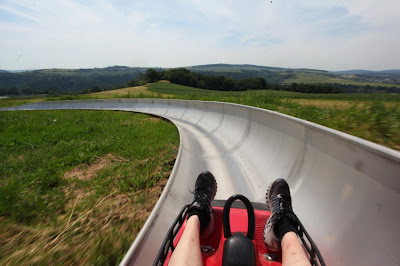
Google Satellite identifies several hotels, restaurants and a sizable camping ground on the plateau, all of which feature great views above the river and probably benefit from the UNESCO designation.  But it seems that a recently-constructed summer bobsled run was one thing too many. 
http://www.spiegel.de
Just this week, the World Heritage Committee issued a statement declaring that the run was "not compatible with the outstanding universal value of the World Heritage property" and calling for its removal.

I'll be on the lookout for tourism run amok when I'm riding past the Loire chateaux.  But I have to say I have trouble seeing this bobsled run as an example.  The World Heritage Committee seems to be okay with places to eat and sleep and park your camper van.  But the bobsled run seems to strike them as just too touristy, too tackily mass touristy. 

http://www.spiegel.de
 I'd probably prefer a beer on one of the restaurant terraces before I took a run on the bobsled.  But it's a little hard to see, from the photo here, how it has more of an impact on the site than do the other tourist facilities.

Meanwhile, commercial barge traffic continues along this stretch of the river below and a little over two years ago one of them capsized near the Loreley rock spilling 2,400 tons sulphuric acid into the river.  One wonders whether the barges and their cargos are "compatible with the outstanding universal value of the World Heritage property?"

Thursday, June 20, 2013

Messy is better


Could a small boat, a chainsaw, and a hand winch be enough to bring a river back to life?  Possibly, in some cases.  An example comes from the River Bure, a short river, only about 50 long, flowing through Norfolk in northeastern England.  It joins the River Yare at Great Yarmouth just before reaching the North Sea.


A little north of the city of Norwich, the river passes through the Blickling Estate, a large country house and grounds managed by England's National Trust since the 1940s.  In the past, the river had been dredged and meanders blocked off to accommodate several nearby mills using the water power.  Trees that might fall into the river were regularly cleared away.  A visitor to the Estate might see an attractive country steam (below), but, in fact, the channelizing and debris clearing had seriously undermined its vitality.   


© D. Brady.  The National Trust
These measures, it appears, had caused the flow of water to slow down.  As it did so, silt, normally carried farther downstream, fell out and gradually covered over the gravel in the river bed.  Over time this process eliminated many of the spawning grounds for the local brown trout.  Eventually local fishermen and National Trust staff realized something needed to be done to improve the river's ability to support the fish and other plant and animal life.
 

In 2008 and 2010 the two groups undertook to recreate something like natural stream conditions.  This turned out to be fairly easy.  They carefully picked out trees that looked like they were about to fall into the river on their own, cut them, and let them fall into the river, branches, leaves and all.  In a few cases, they needed the hand winch to drag them into the water.

The result has been impressive.  As water squeezed its way around and through the debris, it accelerated and, in doing so, began to wash the silt off of the gravel.  With this, the trout began to return to spawn; the fishermen have recorded their increased numbers.  Some of the silt has been displaced out to the river banks where it has allowed new plants to take root.

© D. Brady.  The National Trust

The result (here) may be a messier looking river, but it appears to be much healthier.  And the lesson has been picked up by environmental agencies in the area; they are now much more likely to let trees that fall into streams just stay there.


Friday, June 14, 2013

Building up protections

Give New York credit for its efforts to learn from last year's Hurricane Sandy.  Less a year after the storm that causing more than $19 billion in damage, New York City, following the State, has now announced proposals aimed at reducing risks of similar damage in future storms. 
 

Last Tuesday, NYC mayor, Michael Bloomberg, described plans to protect vulnerable buildings along the city's 520-mile floodplain.  The proposals including modifying new and existing buildings to reinforce foundations, as well as raise the levels of critical equipment.  They also include proposals to build a system of flood walls, levees, and bulkheads at critical points around the city.  The total cost is estimated at $20 billion, although most expect it to go higher as measures would be implemented.

As I noted the other day, New York City currently has nearly 400,000 people living and working within its 100-year flood plain (which these days are often more like 50-year flood plains).  Generally, the mayor's proposals are aimed at protecting those residents, and in addition, allowing for that number to double over the next 30 years or so.


What's more, the proposals include one seemingly head-scratching idea to use new residential and office development as a means of protecting against storm surge.  The report describes a project the mayor referred to as Seaport City, a complex of apartments and office buildings to be built on landfill extending out from the shoreline below the Brooklyn Bridge.  Quite possibly I'm missing something, but it seems that, while the new development might protect existing territory along that part of the East Side, the new developments would themselves become the at-risk, exposed buildings. 

I know New York City is very different from coastal areas on Long Island where Governor Cuomo has proposed paying landowners to give up their houses and permit the coast to return to something like a natural protective system of dunes and marshes.  I suspect that there's little, if any, of the New York City floodplain where anything similar would be possible.  Still, as one researcher observed, you "can't guarantee protection for infrastructure that is in vulnerable locations."  Yet Mayor Bloomberg's proposals seem prepared to try. 


I'm hoping an interesting debate will follow since there's a lot I need to learn.